Aamaghar Pathshala
Friday, February 6th, was my first day at Aamaghar Pathshala, aama means mother and ghar means house, pathshala means a place to learn/grow-school. Their vision is to create a safe place for every child to grow through education. Because every child is a promise!
On my first day, a taxi picked me up, and we brought Meenu’s father to the school. Meenu, the head of the school, is originally from India and comes from a lower caste. As is customary, after marriage a woman lives with her in-laws. Meenu sees her own parents only once a year, so having them here in Nepal is a gift. Apparently, in the thirteen years she has been head of the school, her father has never visited the school. Now he wanted to see what she has built over the years. Her mother, illitered herself, has always encourage her dochters (6 in total) to be educated.

The school has built such a strong reputation that even a professor from Pokhara University has involved them in a research project. Starting Monday, my daily commute to school will be by bus. In Pokhara there are designated pickup points, but if you need to get off, or if you simply raise your hand along the road—the bus will stop. In the mornings, I take the local bus with Meenu; it passes the school, and the 40-minute ride costs 50 rupees (about €0.30). Twice now, I’ve returned to Pokhara on one of the school buses, which operate differently. The school has two buses, each serving a different direction, one goes further up into the hills, the other back towards Pokhara. The children are picked up and dropped off by the school bus, which stops wherever needed. That’s how all the children are safely picked up or delivered home.
Today, I even got to ride on the back of a motorbike, for a short stretch, but without a helmet. Apparently only the driver needs one. Child, wife, girlfriend, or friend sitting behind is perfectly safe without one… or do they simply believe in karma a little too much?

A short description of the school. It was founded in 2012 by the Friends of Nepali Villages Foundation. The Nepal Development Academy (NDA) was one of the Dutch sponsors, along with Light of Life, Intergas Energy, the Seva Network Foundation, and the local community of Pumdi-Bhumdi. The original building, marked by the foundation stone, is now used for toddlers and kindergarten (ages 2–5). The newer main building houses grades 1–8, referred to as the basic level, roughly equivalent to our grades 3–8 and the first two years of secondary school. This building also contains a computer room and library, where yoga and art classes are held. The schoolyard is used for the morning assembly, recess, and sports.
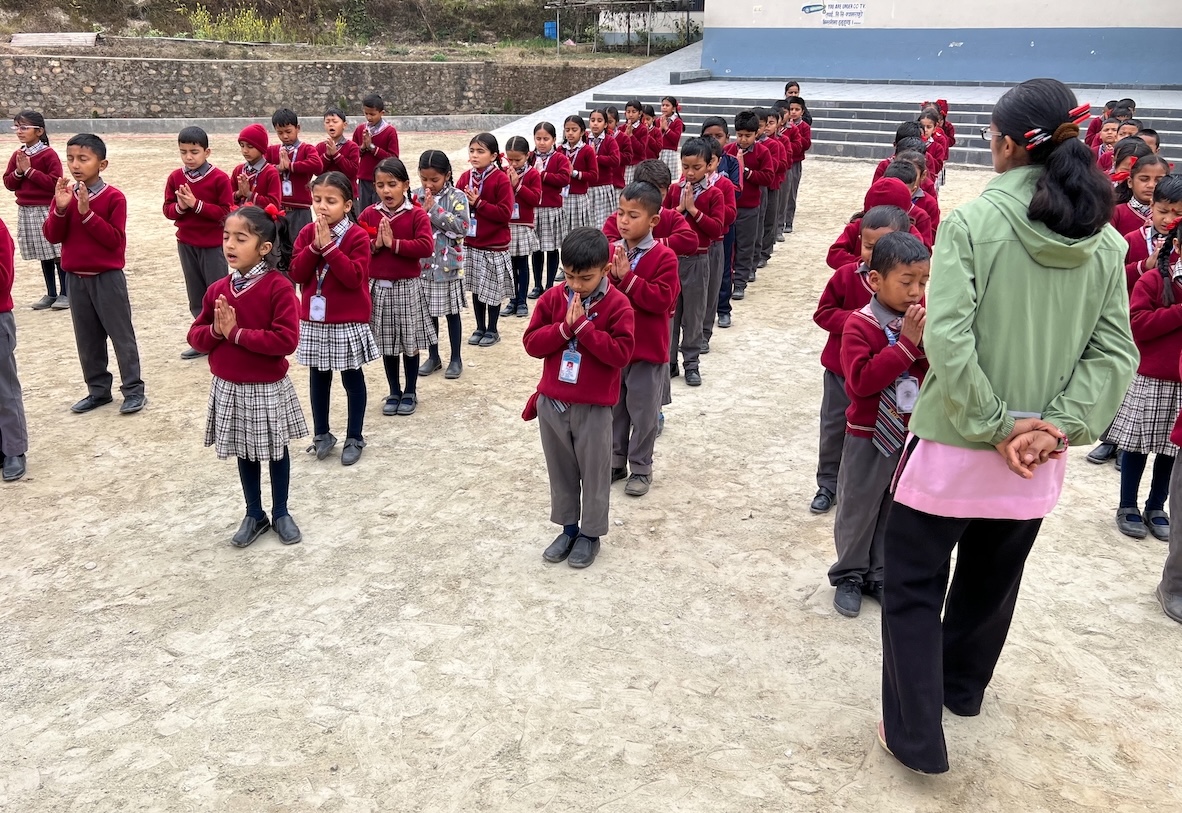
Every day at 10:00 a.m., all students from grades 1–8 line up in rows on the schoolyard. One student beats a drum to set the rhythm for different postures and activities: they begin with physical exercises, followed by singing the national anthem (https://www.youtube.com/watch?v=OURaU_eUBms), and then more movements and stretching. The toddlers and kindergarten children have their own morning ritual, though it isn’t fundamentally different. I would advocate introducing this in The Netherlands too, if students ever aspire to a sports career, at least they would already know the national anthem.
At 10:20, it’s time to go to class. Teachers move from group to group according to their specialization. Only the toddler and kindergarten classes have the same teacher all day. Three day’s, I observed different groups: group 1-5. These are the groups I’ll be working with for an art project in the coming weeks. This way, we get to know each other a bit, and I do my best to share something about myself in Nepali. Fortunately, I also have my sketchbook with me, it’s an universal language. It works like a magnet and is a beautiful way to spark contact and curiosity. But when several children gather around asking you to draw them, the pressure to keep everyone happy can be quite high. 😉
Lunch is at 12:30 for the younger children and 1:00 for the older ones. They receive a meal in the canteen, everyone the same. Except for the teachers. We can choose roti with tarkari (vegetables) and tomato salsa; today there was also bean soup. By now, the cook knows that I really enjoy kalo chiya (black tea) with mint. At home, I never drink tea or coffee with sugar, but here I strangely crave it. Maybe it’s the altitude (822 meters) or the dusty environment, I’m not sure.
The classrooms consist of rows of benches, seating up to three students each. In the younger groups, boys and girls sit alternately. As they grow older, they sit more separately. Is that because of hormones, or do they simply have more say in choosing where to sit?
The writing surfaces are quite narrow and slanted, so you can imagine how often things roll onto the floor.

Trying to understand behavior in a different culture can be challenging. For example, when I was alone in the classroom waiting for the teacher, a child remained at the doorway, hesitant to come in. At first, I didn’t understand what was happening, and the poor student had to repeat the question several times before I realized what he meant. Because when entering a room where adults are present, such as the staff room or a classroom, students first ask for permission to come in.
Well that’s it for now. Soon, I’ll take a trip to Chitwan, to the jungle. We’ve been coming to Nepal since 1994 and have never visited the Terai. We probably won’t see tigers, but mosquitoes, rhinos, elephants, various birds, and perhaps even a crocodile are likely. I will also experience some of the local culture, which I assume differs from that of the mountain communities. I’m curious. More about that later.